Guide
Sunrise 2027 and 2D barcodes: readiness, not a magic deadline
Understand the retail ambition for 2D-capable point-of-sale systems and turn it into a staged testing and data-governance plan.
On this page
Direct answer
Sunrise 2027, also described by GS1 as Ambition 2027 in retail, is an industry goal for retail point-of-sale systems to be capable of reading and processing a defined set of 2D barcodes with GS1 standards by the end of 2027, alongside existing linear barcodes. It is not a universal promise that every retailer, country, category or scanner will accept every 2D symbol on one date.
Organizations should treat it as a readiness programme: define use cases, confirm trading-partner requirements, govern data, select the appropriate carrier, update software and hardware, test real packages and plan coexistence.
What changes in a 2D workflow
A traditional retail linear barcode commonly carries a GTIN for point-of-sale lookup. A 2D barcode can carry more data, such as batch, serial or date information, or a GS1 Digital Link URI that connects an identification key with online services. More capacity creates opportunities, but it also exposes data-quality and system-integration gaps.
The scanner must recognize the carrier. The point-of-sale application must interpret the syntax. Backend systems must decide which fields affect price lookup, traceability, expiry handling or consumer interaction. Packaging artwork must reserve adequate space and quiet zones. Store procedures must handle the period when linear and 2D carriers coexist.
Changing only the printed symbol leaves most of that chain untested.
Worked example
A brand wants to add batch and expiration information while retaining retail checkout. A responsible pilot starts with a documented retailer and product scope. The team identifies which 2D carrier and syntax the application permits, how the point-of-sale system chooses among multiple carriers, and how existing linear symbols remain during transition.
Test data moves through artwork generation, printer output, verifier or inspection equipment, representative scanners, point-of-sale software and business systems. The team records failures by layer rather than declaring the entire symbol “valid” because a phone read a digital image.
TEST / SYNTHETIC / NOT FOR COMMERCIAL USE. Pilot values must be isolated from live item, lot, inventory and consumer records unless authorized production identifiers are used through the approved process.
A practical readiness checklist
Begin with data ownership. Determine who allocates and maintains GTIN, lot, serial, date and URI destination data. Decide which source is authoritative and how corrections are approved. Next, document the selected carrier and the exact GS1 syntax version or application guideline.
Inventory devices and software. Scanner hardware may support imaging but still require firmware or configuration. Point-of-sale and middleware may discard symbology identifiers or separators. Catalogue and traceability systems may not accept additional fields. Consumer experiences add domain, resolver, availability, privacy and content responsibilities.
Finally, test physical production. Include size, substrate, curvature, lighting, ink spread, damage and line speed. Keep results by device and location. Roll out with monitoring and a reversal plan instead of treating a digital self-scan as deployment approval.
Common mistakes
- Interpreting 2027 as a legal deadline that applies identically everywhere.
- Assuming all QR Codes use GS1 Digital Link syntax.
- Assuming every point-of-sale scanner that reads QR Code processes GS1 data correctly.
- Removing the linear barcode before trading partners approve coexistence changes.
- Encoding extra data without ownership, retention or correction rules.
- Using a consumer URL that lacks operational domain and resolver planning.
- Calling a generated preview print-certified.
Limits and what is not checked
BarcodeOpsKit can construct supported data, render selected carriers and perform local digital self-scans. It cannot decide an organization’s migration schedule, interpret every sector rule, verify retailer capability, inspect production equipment, configure a resolver or guarantee a 2027 acceptance outcome.
The project is not affiliated with GS1. Its guides summarize reviewed sources and always defer carrier selection, allocation, conformance and deployment decisions to the applicable official standards and trading partners.
Use the related tool
Use the barcode generator for bounded digital experiments with supported 2D carriers and explicit self-scan evidence. Use the GS1 Digital Link builder when the approved use case requires URI syntax. Neither action sends the entered data to a server.
Sources and review
This guide was reviewed on 2026-07-13 against GS1’s Ambition 2027 support article and the 2D Barcodes at Retail Point-of-Sale Implementation Guideline. The source record captures the review date because rollout guidance can change. Recheck official and local GS1 guidance before a production decision.
Related guides
Read GS1 DataMatrix vs QR Code with GS1 Digital Link for carrier selection and SVG vs PNG for barcode printing before preparing physical artwork.
A 2D migration advances through readiness gates
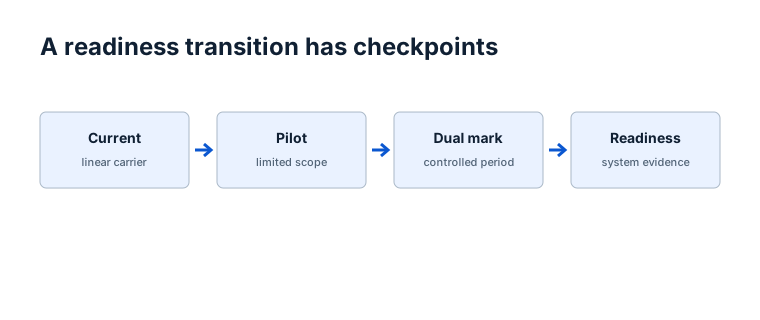
Original workflow aid
2D migration pilot gates
A carrier preview is only one gate. Data ownership, receiving software and physical production need their own evidence and stop conditions.
Related local tool
Continue with the working tool
Test a supported 2D barcode locallySource record
- What is Ambition 2027 in Retail?, GS1. Version or revision: Modified 2025-01-08. Reviewed .
- 2D Barcodes at Retail Point-of-Sale Implementation Guideline, GS1. Version or revision: Reviewed 2026-07-13. Reviewed .