Guide
GTIN-8, GTIN-12, GTIN-13 and GTIN-14 explained
Compare the four GTIN lengths, preserve leading zeros and choose the representation required by the receiving workflow.
On this page
Direct answer
GTIN-8, GTIN-12, GTIN-13 and GTIN-14 are fixed-length forms of the Global Trade Item Number. Their names state the total number of digits, including the final check digit. They support different allocation and application contexts, but all four should be stored and exchanged as character strings.
Do not choose a form only by adding zeros until a field accepts the value. Start with the identifier assigned for the trade item, then follow the documented representation required by the receiving system. Preserve both the source and any explicit normalized representation.
What each length tells you
GTIN-8 has eight digits and is commonly associated with items where packaging space is constrained, subject to allocation rules. GTIN-12 has twelve digits and is the form commonly called UPC in North American retail contexts. GTIN-13 has thirteen digits and is often called EAN. GTIN-14 has fourteen digits and is used as the common database representation and for trade-item identification contexts that include packaging levels.
Length does not reveal a product name or owner. It also does not prove that the number was allocated. The internal composition depends on the allocation arrangement, and a local validator should not guess company identity from a prefix.
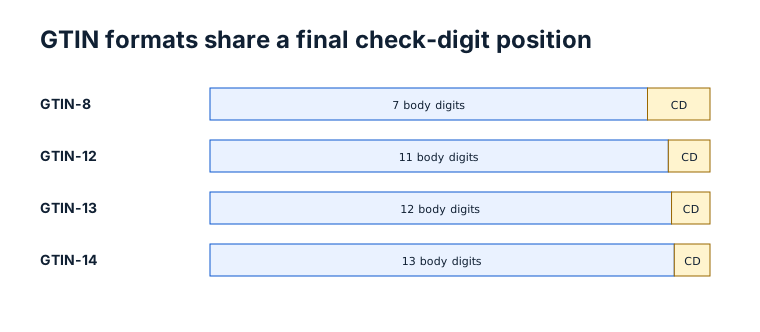
Every supported form ends with a Modulo-10 check digit. The body lengths are therefore 7, 11, 12 and 13 digits respectively. This distinction is useful when a calculator asks whether the user entered a body or a complete number.
Worked example
Suppose a data file contains a value that visually appears to have eleven digits, while the source label shows twelve characters beginning with zero. The spreadsheet probably treated the value as a number and removed the leading zero. The correct recovery is to re-import the source column as text, not to guess which zero belongs at the front.
In another workflow, a trading-partner interface documents a fourteen-character GTIN field. A shorter GTIN may be represented with left padding in that specific interface. That normalized database representation must be distinguished from issuing a new identifier or changing the value printed in its original carrier.
TEST / SYNTHETIC / NOT FOR COMMERCIAL USE. The examples describe data handling and do not supply an assigned GTIN.
Selecting a calculator mode
If you have a complete GTIN, select full-number validation and keep the final character as the entered check digit. If you have only the body, select the intended GTIN type before calculating. A 12-digit input is ambiguous without context: it can be a complete GTIN-12 or the body from which a GTIN-13 check digit will be produced.
No-guess behavior is safer than convenience. A tool should show possible interpretations and ask for a selection. Silent classification can generate a plausible but wrong result that later passes a structural check.
For batch data, map the identifier column explicitly. Do not validate every numeric-looking column, and do not coerce blank cells or scientific notation into identifiers.
Common mistakes
- Counting only body digits and forgetting that the name includes the check digit.
- Treating a GTIN as an integer and losing leading zeros.
- Assuming GTIN-14 always means a shipping container; packaging and identification context still matter.
- Converting every shorter value to fourteen digits without a receiving-system requirement.
- Assuming GTIN-12 and UPC-A describe identical concepts in every sentence; one is the identifier form and one is a carrier name.
- Reading country or ownership conclusions from visible prefix digits.
Limits and what is not checked
Length, numeric characters and a matching final digit establish structural evidence only. BarcodeOpsKit does not allocate GTINs, verify a GS1 Company Prefix, confirm registration or ownership, identify the product or packaging level, or decide which representation a trading partner requires.
The validator also does not inspect the carrier. A correct GTIN can be encoded in a symbol that is too small, clipped, low contrast or otherwise unsuitable for physical scanning. Conversely, readable bars can contain an unassigned or incorrectly associated number.
Use the related tool
Use the GTIN, UPC and EAN validator for a complete value. It preserves leading zeros, lists possible supported interpretations and shows expected versus entered check digits. Use the check digit calculator when you have a body and an explicitly chosen GTIN form.
Sources and review
This guide was reviewed on 2026-07-13 against GS1 General Specifications 26.0.0 and the GS1 Identification Keys reference material. The review records structure and terminology, not an allocation or ownership lookup. BarcodeOpsKit is independent from GS1.
Related guides
Read GTIN vs UPC vs EAN for identifier-versus-carrier terminology and How GS1 check digits work for the shared Modulo-10 method.
Four GTIN lengths share one final position
Original workflow aid
GTIN length reference
The form name counts the complete identifier, including its final check digit; every value must remain a string.
Related local tool
Continue with the working tool
Check a complete GTINSource record
- GS1 General Specifications, GS1. Version or revision: 26.0.0. Reviewed .
- GS1 Identification Keys reference card, GS1. Version or revision: Reviewed 2026-07-13. Reviewed .