Guide
Check digit valid vs registered: two different questions
Understand why a structurally valid identifier is not proof of GS1 issuance, company ownership, product identity or retailer acceptance.
On this page
Direct answer
“Check digit valid” means the final digit matches a calculation performed on the preceding characters. “Registered” or “assigned” means an authorized organization has allocated the identifier under the applicable system and business records connect it to an entity or item. These are different questions, answered by different evidence.
A local calculator can answer the structural question without a network request. It cannot establish registration, ownership or product identity. BarcodeOpsKit deliberately reports what it calculated and lists the claims it did not test.
A practical evidence ladder
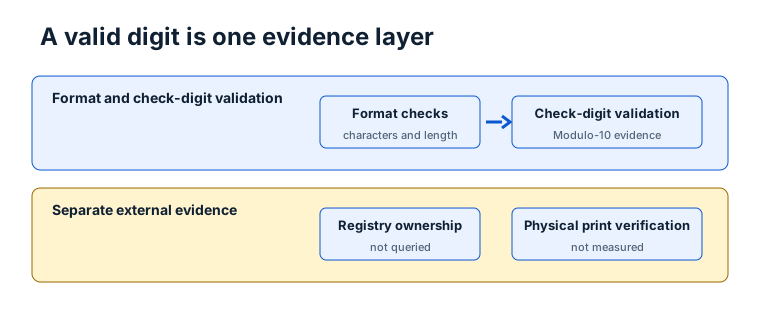
Start with character evidence: is the input numeric where the selected key requires digits? Next check length: does it match GTIN-8, GTIN-12, GTIN-13, GTIN-14, GLN-13 or SSCC-18? Then calculate the expected final digit and compare it with the entered digit.
Those checks can identify a malformed or mistyped value. Passing them means only that the string is structurally consistent with the chosen format. The next evidence level is assignment: was the identifier allocated through an authorized process? Beyond that are ownership and business association: which organization controls it, and what item or location record is connected to it?
Retailer acceptance is another layer. A marketplace may require a particular identifier type, verified account relationship, category rule, packaging state or catalogue record. None of those policies are encoded in a check digit.
Worked example
Imagine two fictional strings with the same supported length. The first has a mismatched final digit. The validator can reject its structure immediately. The second has a matching final digit. The validator can report structural success, but it still has no evidence that the body was allocated, that a company owns it or that a product exists.
An arbitrary body can always be paired with its mathematically correct check digit. That fact is useful for software testing, but it is exactly why a passing calculation is not registration evidence.
TEST / SYNTHETIC / NOT FOR COMMERCIAL USE. Synthetic test values are appropriate for unit tests and demonstrations, not for product listing, logistics or commercial labels.
How to verify the next layer
Use the authoritative process for the identifier and the business relationship. That may involve records held by the organization that assigned the number, GS1 services available to the responsible company, supplier documentation or a retailer’s onboarding workflow. Access, scope and conclusions vary; do not turn a local syntax result into a broad registry claim.
When correcting a mismatch, compare the full value with its source. Do not automatically replace only the final digit. If a body digit was mistyped, changing the check digit would conceal the original error while creating a different structurally valid string.
Keep an audit trail that distinguishes original input, normalized display, calculated expectation and any human-approved correction. This separation is especially important in batch files, where silent repairs can propagate widely.
Common mistakes
- Describing a matching digit as “official,” “verified” or “registered.”
- Assuming a barcode image proves the underlying number was assigned.
- Searching a product catalogue and treating absence as proof that a number is invalid.
- Treating a registry match as physical print certification.
- Assuming one retailer’s acceptance guarantees another retailer’s policy.
- Generating random bodies with correct digits and using them commercially.
- Automatically correcting exports without preserving the source value.
Limits and what is not checked
BarcodeOpsKit does not issue identifiers, validate a GS1 licence, confirm a company prefix, establish ownership, identify a product or location, test a live resolver, inspect retailer rules or guarantee marketplace acceptance. It also does not grade physical barcodes.
Digital rendering and self-scan are separate evidence. They can show that a local decoder reads generated pixels, but they do not verify print dimensions, quiet zones after artwork placement, contrast, substrate, damage, scanner configuration or formal verification equipment.
Use the related tool
The GTIN, UPC and EAN validator reports detected formats, character and length evidence, expected and entered digits, and explicit scope limitations. For a transparent formula trace, use the check digit calculator.
Sources and review
This interpretation was reviewed on 2026-07-13 against GS1 General Specifications 26.0.0 and the repository’s local validation contract. Source metadata records the standards version and publisher. BarcodeOpsKit is not affiliated with or endorsed by GS1 and makes no approval claim.
Related guides
Read How GS1 check digits work for the arithmetic and GTIN vs UPC vs EAN for terminology that often causes the structural and business layers to be mixed together.
Where check-digit evidence stops
Original workflow aid
Evidence layers that must stay separate
Use this ladder to describe exactly what a local result establishes and which question still needs a different source.
Related local tool
Continue with the working tool
Inspect structural validation evidenceSource record
- GS1 General Specifications, GS1. Version or revision: 26.0.0. Reviewed .